
Data-Driven Optimization of Migratory Beekeeping Decisions Through Floral Calendar and NDVI-Based Spatial Analysis
Citation
Deniz, H. (2026). Data-Driven Optimization of Migratory Beekeeping Decisions Through Floral Calendar and NDVI-Based Spatial Analysis. Paper presented at the Proceedings of the BEE-OPTIMA International Workshop on ICT-enabled Optimization and Digital Innovation in Beekeeping, 25-44.Abstract
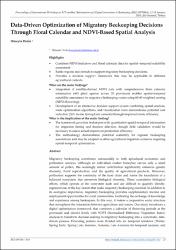
Migratory beekeeping contributes substantially to both apicultural economics and polli-nation services. Although an individual worker honeybee carries only a small amount of pollen, this seemingly minor contribution significantly enhances genetic diversity, floral reproduction, and the quality of agricultural products. Moreover, pollination supports the continuity of the food chain and forms the foundation of a balanced ecosystem that pre-serves biological diversity. These cumulative biological effects, which operate at the eco-system scale and are difficult to quantify directly, represent one of the key factors that make migratory beekeeping essential. In addition to its ecological importance, migratory beekeeping provides supplementary income and employment opportunities for rural communities, facilitating the exchange of knowledge and experience among beekeepers. In this way, it fosters a cooperative social structure that strengthens the interaction between agriculture and nature. Our study introduces a digital optimization framework that com-bines a calendar of flowering periods at the provincial and district levels with NDVI (Normalized Difference Vegetation Index) analysis to transform decision-making in mi-gratory beekeeping into a systematic, data-driven process. Flowering periods were divided into six temporal windows (Winter, Spring Early, Spring Late, Summer, Autumn, Late Autumn) for temporal analysis, and NDVI values were derived from Sentinel-2 satellite imagery to characterize vegetation condition across regions. Province-level suitability was then calculated by combining flowering intensity scores with normalized NDVI values using weighted criteria (60% NDVI, 40% flowering). This integration enabled the system-atic ranking of locations and periods according to their potential for migratory beekeeping operations.
The following license files are associated with this item:

Except where otherwise noted, this item's license is described as info:eu-repo/semantics/openAccess