
Stress Factors in Honeybee Colonies and Prevention Possibilities
| dc.contributor.author | Yücel, Banu | en_US |
| dc.contributor.author | Varol, Ekin | en_US |
| dc.date.accessioned | 2026-06-24T11:41:46Z | |
| dc.date.available | 2026-06-24T11:41:46Z | |
| dc.date.issued | 2026-01-13 | |
| dc.identifier.citation | Yücel, B. & Varol, E. (2026). Stress Factors in Honeybee Colonies and Prevention Possibilities. Paper presented at the Proceedings of the BEE-OPTIMA International Workshop on ICT-enabled Optimization and Digital Innovation in Beekeeping, 82-89. | en_US |
| dc.identifier.isbn | 9789756494561 | |
| dc.identifier.uri | https://belgelik.isikun.edu.tr/xmlui/handle/iubelgelik/7305 | |
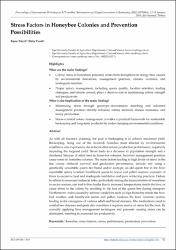
| dc.description.abstract | As with all livestock planning, the goal in beekeeping is to achieve maximum yield. Bee-keeping, being one of the livestock branches most affected by environmental conditions, also experiences stress factors that reduce production performance, negatively impacting the targeted yield. Stress leads to a decrease in population strength and a shortened lifespan of adult bees in honeybee colonies. Incorrect management practices cause stress in honeybee colonies. The main factors leading to high levels of stress in the bee colony, re-duced survival and production performance, include: not using a genetically unsuitable queen bee breed and/or ecotype; an old queen bee in the hive; unsuitable apiary location; insufficient access to nectar and pollen sources; exposure of hives to excessive heat and inadequate ventilation and poor wintering practices. Failure to adhere to necessary tech-nical rules, particularly during the transportation of honeybees to nectar sources, can lead to bee deaths due to increased temperatures inside the hive, or cause stress to the colony by resulting in the loss of the queen bee during transport. Furthermore, stress caused by ad-verse conditions such as high humidity inside the hive, bad weather, and insufficient nectar and pollen weakens the bees’ immune system, leading to the emergence of various adult and brood diseases. The medications used to combat bee diseases and pests also constitute a separate source of stress for the bees. By correctly applying hive management techniques and prevents causing stress can be eliminated, resulting in increased bee productivity. | en_US |
| dc.language.iso | eng | en_US |
| dc.publisher | Işık University Press | en_US |
| dc.relation.ispartof | Proceedings of the BEE-OPTIMA International Workshop on ICT-enabled Optimization and Digital Innovation in Beekeeping | en_US |
| dc.rights | info:eu-repo/semantics/openAccess | en_US |
| dc.rights | Attribution-NonCommercial-NoDerivs 3.0 United States | * |
| dc.rights.uri | http://creativecommons.org/licenses/by-nc-nd/3.0/us/ | * |
| dc.subject | Honeybee | en_US |
| dc.subject | Stress factors | en_US |
| dc.subject | Colony performance | en_US |
| dc.subject | Production | en_US |
| dc.subject | Prevention | en_US |
| dc.title | Stress Factors in Honeybee Colonies and Prevention Possibilities | en_US |
| dc.type | conferenceObject | en_US |
| dc.description.version | Publisher's Version | en_US |
| dc.authorid | 0000-0003-4911-7720 | |
| dc.authorid | 0000-0003-4382-5427 | |
| dc.identifier.startpage | 82 | |
| dc.identifier.endpage | 89 | |
| dc.peerreviewed | Yes | en_US |
| dc.publicationstatus | Published | en_US |
| dc.relation.publicationcategory | Konferans Öğesi - Ulusal - Başka Kurum Yazarı | en_US |
Bu öğenin dosyaları:

Bu öğe aşağıdaki koleksiyon(lar)da görünmektedir.
-
BEE-OPTIMA International Workshop on ICT-enabled Optimization and Digital Innovation in Beekeeping [7]
BEE-OPTIMA International Workshop on ICT-enabled Optimization and Digital Innovation in Beekeeping Bildiri Kitabına ait bildirileri içerir.

Aksi belirtilmediği sürece bu öğenin lisansı: info:eu-repo/semantics/openAccess